Sunday, February 17, 2013

What a Fellowship

By Eric Stradford

Economic Security alternatives to Violence/Gun Control

image

AMWS, February 17, 2013, Atlanta -- A creditable threat to America’s national security hinges from a nation divided. On one side, citizens are “Organizing For Action” in support of the nation’s constitutionally elected executive leadership. Opposition, stemming from the right, wants to keep things pretty much the way things have been, or in other words, resist change.

At ground zero, the Second Amendment to the Constitution – a right to bear arms for anyone who can afford to legally purchase, license and secure one or more weapons. Citizens who cannot afford to legally “secure the blessings of liberty,” either acquire weapons illegally or pursue other economic security options.

Music teacher Anthony J. Showalter, in 1887, perhaps set to music a course for common vision charted by Elisha A. Hoffman in his enduring inspirational hymn, “What a fellowship, what a joy divine.” Showalter, after hearing from two friends whose wives had died, asked Hoffman to write the lyrics:

Leaning, leaning, safe and secure from all alarms;

Leaning, leaning, leaning on the everlasting arms.

The song, featured in the 1943 movie The Human Comedy, starring Mickey Rooney, was nominated for Academy Awards in five categories, including Best Picture and Best Actor. William Saroyan won Best Original Story for the film. Over the years a diverse cadre of ministers and performers have added value to the hymn’s central theme, trust.

Citizens on both sides of America’s economic security dilemma perhaps grew up humming Showalter’s tune without fully valuing the wisdom in Hoffman’s lyrics, “What a fellowship, what a joy divine, leaning on the everlasting arms. What a blessedness, what a peace is mine, Leaning on the everlasting arms.”

As early as 1871, the issue of Gun Control was being addressed by the U.S. Congress. Dismayed by the lack of marksmanship shown by their troops, Union veterans Col. William C. Church and Gen. George Wingate formed a fellowship of sorts known today as the National Rifle Association. The primary goal of the association would be to "promote and encourage rifle shooting on a scientific basis," according to a magazine editorial written by Church.

Since its inception, the NRA has been widely recognized as a major political force and lauded as the premier firearms education organization in the world. "They're good citizens,” a former aide to President Bill Clinton once commented. “They call their congressmen. They write. They vote. They contribute. And they get what they want over time," said George Stephanopoulos.

Among the best lessons to draw from the NRA is its practice of reinvesting historic values in America’s future. They choose 45 high school sophomores and juniors from across the United States each year to travel to the nation’s capital, where they participate in the weeklong educational opportunity. The Youth Education Summit (Y.E.S.) encourages young adults to become active and knowledgeable U.S. citizens by learning about the Constitution and Bill of Rights, the federal government, and the importance of being active in civic affairs.

Since the program’s inception in 1996, more than 675 students have graduated from Y.E.S. and over $385,000 in scholarships have been awarded. Entry into the program requires submission of a completed application form, high school transcript, three-page essay on the Second Amendment, one-page personal statement, and three letters of recommendation. The application deadline is Tuesday, February 19th.

The White House appears to be engaged in education, training, jobs and security. “After shedding jobs for more than 10 years, our manufacturers have added about 500,000 jobs over the past three,” said President Obama. “What we need to do now is simple. We need to accelerate that trend. We need to launch manufacturing hubs across the country that will transform hard-hit regions into global centers of high-tech jobs and manufacturing…. And we need to invest in the research and technology that will allow us to harness more of our own energy and put more people back to work…”

Companies in the United States that manufacture, distribute and sell firearms, ammunition and hunting equipment employ as many as 98,752 people in the country and generate an additional 110,998 jobs in supplier and ancillary industries. These include jobs in companies supplying goods and services to manufacturers, distributors and retailers, as well as those that depend on sales to workers in the firearms and ammunition industry.

Industry revenues represent an economic impact of some $31,838,799,763. This does not include black market sales. The $32 billion firearms industry creates jobs, paying an average of $46,858 in wages and benefits. At the same time, supply and demand which drives the industry disproportionately impacts economically underserved Americans.

Increasing evidence of a national security threat is reflected in concerns raised by African American leaders.

  1. The growth of weapon sales to African-Americans drains local funds that could be used for economic development, business investments, job creation, home ownership, savings and community empowerment.
  2. The increase in gun sales in African-American communities is directly related to the lack of education, training, jobs and income.
  3. More weapon sales to African-Americans create a permanent under-class for this segment of society. It results in a new form of slavery.
  4. Escalating the number of deaths in the African-American community reduces their population growth.
  5. The increase of crime in African-American communities destroys the historical legacy of positive values and creates a negative lifestyle in these neighborhoods.
  6. The fear that was embraced by slave owners is now perpetuated by the gangs and gun owners.
  7. The industry perpetuates the “have” and “have-not” mentality by implication that those who own guns can and will rule over those who do not.

It seems that the government’s need to protect citizens and the firearms industry’s desire to protect constitutional rights are close enough for compromise. An increase in manufacturing jobs appears to be in everybody’s interest. So, what can America manufacture to address lost revenue in firearms sales?

Youth Achievers USA Institute (YouthUSA), a national 501c3 public charity applies the wisdom of Elisha A. Hoffman’s “What a Fellowship,” to a win-win vision for America’s economic future. “Clearly there is a need to restore trust,” said Stephanie A. Walker Stradford, the organization’s chief executive officer. “Disadvantaged Americans are overrepresented as victims of gun violence in places where most citizens cannot afford to legally buy or maintain weapons. It is logical to ask, where are the guns coming from, how are they getting into underserved communities and who economically benefits?”

America’s faith community represents a significant force in securing the blessings of liberty. But, up to now, our problems continue to be incubated in a house divided. YouthUSA has called on faith-based friends from both ends of the gun to INCREASE THE PEACE where they live, learn, work and worship.

Each year since 1996, YouthUSA has hosted THE ANNUAL YOUTH ACHIEVEMENT AWARDS program to qualify beneficiaries age 7-24 from across the United States. The organization partners with communities of faith on grants and contracts to support Main Street, USA economic initiatives. The ASSETS FOR INDEPENDENCE program calls for projects that invest in economically disadvantaged Americans. YouthUSA hopes to qualify “fellows” to participate in conversations that impact their economic future.

The Alliance for Economic Inclusion (AEI) is a national initiative to establish broad-based coalitions of financial institutions, community-based organizations and other partners in several markets across the country to bring all unbanked and underserved populations into the financial mainstream.

The banking industry can and must do more to fulfill its obligations under Community Reinvestment laws. Too many banks find it too easy to say no instead of let’s try.

The Federal Deposit Insurance Corporation (FDIC), an independent agency created by Congress to maintain stability and public confidence in the nation's financial system, established this “fellowship” because a significant number of people in the U.S. have little or no current relationship with a financial institution.

Economic barriers, such as lack of funds to carry account balances and bank fees; structural barriers (e.g., prior bad experiences, ChexSystems, lack of sufficient ID); and experiential barriers (unfamiliarity and distrust of banks) are the most common reasons for being unbanked. The unbanked and under-banked rely on a mix of non-bank money service providers and will pay the high fees with these alternative providers in exchange for the convenience and ease in cashing checks, paying bills and accessing cash.

By accessing the mainstream financial system, these households can build savings and improve their credit-risk profiles in order to lower their cost of payment services, eliminate a common source of personal stress, and gain access to basic financial services that promote asset accumulation.

$500,000 Grant Award

Project Safe Neighborhoods (PSN) is designed to create safer neighborhoods through a sustained reduction in crime associated with gang and gun violence, and violent offenders. The program's effectiveness is based on the cooperation of local, state, and federal agencies engaged in a unified approach led by the U.S. Attorney (USA) in each district. The USA is responsible for establishing a collaborative PSN task force of federal, state, and local law enforcement and other community members to implement gang and gun crime enforcement, intervention and prevention initiatives within the district. Through the PSN task force, the USA will implement the five design features of PSN—partnerships, strategic planning, training, outreach, and accountability—to address specific gun and gang crime, and violent offenders, in the most violent neighborhoods.

Details on the five design features (also referred to as core elements) can be found later in this grant announcement and online. The Department of Justice has transitioned the PSN program from a formula-based allocation of funding to a competitive-based program. In a competitive environment, “need” and use of more effective, intelligence- and data-driven strategies will be key factors for funding selections, in addition to performance results and other factors. Therefore, grant awards for FY 2013 will be made through a competitive process to encourage and focus funding in high-performing and evidence-based programs where the need is greatest and where the most violent neighborhoods, within districts, are being addressed. Funding for this initiative is anticipated through the FY 2013 appropriation.

SEE FULL ANNOUNCEMENT

PARTNER WITH YOUTHUSA

Monday, December 17, 2012

Broken Promise

How will America keep its children safe?

by Stephanie and Eric Stradford

AMWS, December 17, 2012, Atlanta – Twenty more American children are being mourned this week. They and six of their teachers were slain Friday by a lone gunman. They were at “school” getting set for another day of learning in Newtown, Connecticut. To our public knowledge, no official has described Friday’s shooting at Sandy Hook Elementary School as an act of terror. No homeland security breach has been logged. No national security threat has been alleged.

Before Newtown, before Sanford, before Virginia Tech, before Columbine, before 9-11-2001, America promised safe places to learn. But America’s Promise of a safe place to learn is today another promise broken.

The President of the United States came to offer the “love and prayers” of a nation. “Our world too has been torn apart; that all across this land of ours, we have wept with you…we've pulled our children tight,” said President Obama. “Whatever measure of comfort we can provide, we will provide; whatever portion of sadness that we can share with you to ease this heavy load, we will gladly bear it. Newtown -- you are not alone.”

The president’s on-site assessment of the tragedy at Sandy Hook Elementary School gave measure to a certain reality about raising 21st Century America. “With their very first cry, this most precious, vital part of ourselves -- our child -- is suddenly exposed to the world, to possible mishap or malice. And every parent knows there is nothing we will not do to shield our children from harm,” he said. “This job of keeping our children safe, and teaching them well, is something we can only do together, with the help of friends and neighbors, the help of a community, and the help of a nation.”

A veteran of the U.S. Armed Forces is perhaps among the most frustrated of American citizens. They know that something can be done. Since 2001, about 2,000 American service men and women have died in Afghanistan; in that same time period, 5,000 people have died in Chicago.

The biggest problem returning veterans face has been finding believers, or converting unbelievers before they themselves lose it. Too many Americans see raising American children as a job. We outsource the solution as “students” to teachers in 19th century environments labeled as “schools.” But raising America, like raising the stars and stripes, is an investment in social enterprise.

In this economy that child is the GNP. Any threat on his or her life is a national security breach. Sustaining children through their holistic development answers the call for change in the business of educating a generation of lifelong learners.

Let’s face it! Tops down government can’t even fund a kept promise. So, what if we were to try a bottoms-up faith-based approach? We’ve been doing that since Jesus came and have still not fully embraced the possibilities. So, what about this new strategy? Have the wealthy pay more in taxes, engage the poor with a hand up, and restore America from the middle out.

The “measure of comfort” promised by the president to a grieving nation perhaps answers the “what can be done?” question. The national debate is now shifting from fiscal cliff to how we spend less to get more out of the American people. There is no shortage of resources for keeping children safe in America. But for one day, in just a few minutes, America was attacked…again. Don’t blame the first responders. Don’t blame the politicians. Don’t blame the teachers, the parents, the school bus drivers. And, don’t blame God!

Blame terror. Once the dust clears, history almost always reveals both problem and a pathway to one or more solutions. When terrorists struck on September 11, 2001, America responded with a whole new tops-down strategy.

The federal government has since spent more than half a trillion dollars on homeland security—that is, activities that detect, deter, protect against, and respond to terrorist acts occurring within the United States and its territories. The President’s request of $68.9 billion to fund the Department of Homeland Security is 1.3 percent more than the amount provided for 2012. Every cabinet-level department receives homeland security funding, with the lion’s share allocated to:

  • Department of Homeland Security (DHS—$35.5 billion, or 52 percent of the total homeland security request);
  • Department of Defense (DoD—$17.9 billion, or 26 percent);
  • Department of Health and Human Services (HHS—$4.1 billion or 6 percent); and
  • Department of Justice (DOJ—$4.0 billion or 6 percent).

The U.S. Department of Education currently administers a budget of $68.1 billion in discretionary appropriations (including discretionary Pell Grant funding) and operates programs that touch on every area and level of education. The Department's elementary and secondary programs annually serve nearly 16,000 school districts and approximately 49 million students attending more than 98,000 public schools and 28,000 private schools. Department programs also provide grant, loan, and work-study assistance to more than 15 million postsecondary students.

Homeland security is an umbrella term for security efforts to protect states against terrorist activity. Specifically, it is a concerted national effort to prevent terrorist attacks within the U.S., reduce United State’s vulnerability to terrorism, and minimize the damage and recover from attacks that do occur.

National security is the requirement to maintain the survival of the state through the use of economic power, diplomacy, power projection and political power. The concept developed mostly in the United States of America after World War II. Initially focusing on military might, it now encompasses a broad range of facets, all of which impinge on the non military or economic security of the nation and the values espoused by the national society.

To possess national security, a nation needs to possess economic security, energy security, environmental security, etc. Security threats involve not only conventional foes such as other nation-states but also non-state actors such as violent non-state actors, and lone gunmen. Known measures to ensure national security include:

  • using diplomacy to rally allies and isolate threats
  • marshaling economic power to facilitate or compel cooperation
  • maintaining effective armed forces
  • implementing civil defense and emergency preparedness measures (including anti-terrorism legislation)
  • ensuring the resilience and redundancy of critical infrastructure
  • using intelligence services to detect and defeat or avoid threats and espionage, and to protect classified information
  • using counterintelligence services or secret police to protect the nation from internal threats

At what point will measures of comfort, both known and unknown be applied to protecting America’s Future? At what point can America’s future value America’s Promise?

Saturday, November 10, 2012

A Moment in History’s Shadow

By Eric and Stephanie Stradford

clip_image002[6]

ABOVE: General P.X. Kelley pictured with Attorney Herb Harmon ( c ) at Bobby Vans Grill. The 28th Commandant of the Marine Corps invoked an enduring spirit during the annual gathering of the “Gang of Thirty,” commemorating the 237th Marine Corps Birthday. BELOW:  Insight on the commandancy.

clip_image002[4] clip_image004[4] clip_image006 clip_image008 clip_image010[4] clip_image012[4] clip_image014[4]
Nicholas
LeJeune
Barrow
Kelley
Gray
Jones
Amos


AMWS, November 10, 2012, Washington, DC – Hard-chargin’ U.S. Marine Lance Corporal Dennis LeNard experienced something special about the Corps he served from 1989-1993. Now, Staff Director, Congressional Marines for the Office of Legislative Affairs of the U.S. House of Representatives, LeNard’s purpose and presence at the U.S. Capitol is to remind America’s elected that one voice can make a difference.

In true Marine fashion, LeNard charged up Capitol Hill to share what he had experienced only moments before at Bobby Van’s Grill in Northwest Washington, DC. Jim Hickey, the business owner had set a table for “calling to mind the glories” of United States Marines. The 28th Commandant of the Marine Corps stepped out from the shadows of legend and lore to reset America’s compass for a new direction forward.

On the eve of the Corps’ 237th Birthday, the oldest living commandant sowed into a gathering of seasoned leathernecks from his own vault of American values. “Gen. Kelley is an absolute hero to our Corps. We love him, we respect him, we revere him.” said General James F. Amos. “He’s a man of courage, a man of integrity and a great American patriot.”

The 35th Commandant of the Marine Corps was in “virtual” attendance at the annual gathering of the “Gang of Thirty.” But the “almost spiritual, religious bond between former and living Commandants” added value to service for those in the room and their reach around the globe, sharing the legacy of United States Marines. “The Gang” includes some of Washington, DC’s elite movers and shakers, maintaining a presence in almost every sector of government and society. Almost every commandant since Kelley has honored the occasion with a physical presence.

Marine Colonel Herbert N. “Herb” Harmon of DC’s prestigious Harmon and Wilmot law firm has perpetuated “espirit de corps” in the nation’s capitol for as long as any living Marine. That esprit de corps is “the capacity of a group's members to maintain belief in an institution or goal, particularly in the face of opposition or hardship.” According to Kelley, Harmon spearheaded the Marine Corps Marathon, an annual event the general refers to as “The Race.” Harmon stepped into race founder Colonel Jim Fowler's footprints and has since chaired the Marine Corps Marathon Ad Hoc Publicity Committee.

Harmon served as a platoon commander in Vietnam in 1968 and retired from the Marine Corps reserve in 1998. He is a member of the Military Order of the Purple Heart, former National Judge Advocate General of the Marine Corps Aviation Association and a member of the Marine Corps League. He also served as the Reserve Officers Association National President from 1997-1998.

A word from the current Commandant of the Marine Corps added purpose to General Kelley’s participation, value to the commandancy, and vision for forward movement. “You know, I’ve been in the job now for about 18 days,” said General John F. Amos shortly after assuming command of the Marine Corps October 22, 2010.

“During the days of preparation before taking it – this wonderful job that I’ve been blessed with – I spent time with every living Commandant. Gen. P.X. Kelley, our oldest and most distinguished living Commandant and I spent an afternoon together. And it was like – my goal that evening was to pick his brain on all of those things that are unique to the office: those things that surprised him, those things that he felt very good about, those things, those pearls that he might want to pass on to me.”

Tomorrow, November 11th, Veterans Day, the family of U.S. Marines celebrates General Kelley’s 84th birthday, and a shared legacy as “the most faithful patriot and leader in service to our nation.” As I stood in General Kelley’s shadow for a moment after 40 years of active and retired life as a U.S. Marine, something clicked. It was louder than the sound a Marine rifleman hears right after B.R.A.S.S. I felt the presence of fallen heroes and wounded warriors whose blood, flesh and spirit define America as a nation.

Sometimes America needs to be reminded. That hard-chargin’ Marine Lance Corporal, in the midst of our nation’s elected, stands on the shoulders of the commandancy and every U.S. Marine. His “caucus” looked more like a fire-team of emerging leaders with no sense or fear of failure. Greg Jones, son of 32nd commandant and 22nd National Security Advisor General Jim Jones, seemed to be a natural for guiding common sense conversation.

The younger Jones has stood in the shadow cast by Harmon, Fowler and other ordinary Marines sustaining the extraordinary legacy of United States Marines. If ever a commander-in-chief and a congress needed a “What’s next?” in a period of uncertainty…they need just ask a Marine! Every one of us knows that FORWARD is part one (preparatory) of a two part order. Forward movement almost always follows with the command of execution, “MARCH!”


Monday, October 22, 2012

Why Every 1 in 6 Million Ohioans Need To Vote Early

By Eric and Stephanie Stradford
image

AMWS, October 21, 2012, Cleveland, OH – The State of Ohio reported that 1.4 million Ohioans have either cast or requested an absentee ballot for the November 6 General Election. The Ohio Secretary of State’s website now informs the last of 7.9 million Ohio voters WHERE they can go for early voting. 

UPDATE (3:49 pm 10/22) --  Find Your Polling Location

Ohio Secretary of State Jon Husted’s “encouragement” could have been a little more enthusiastic since voting is one of those inalienable rights celebrated through American citizenship. Instead, regarding the U.S. Supreme Court’s denial of a stay of the Sixth Circuit Court of Appeals’ decision in Obama v. Husted, the Secretary told Ohioans, “Despite the Court’s decision today, to deny our request for a stay, I firmly believe Ohio and its elected legislature should set the rules with respect to elections in Ohio, and not the federal court system.”

The Ohio Secretary of State issued DIRECTIVE 2012-50 to all County Boards of Elections which, “expands the uniform days and hours for in-person absentee voting established by Directive 2012-35, which remains in effect. As such, Boards are reminded that any voter in line when that day’s hours for in-person absentee voting ends may remain in line to apply for and receive an absentee ballot in person.”

If you are one of the 6.5 million Ohioans who have not voted, you should vote:

Saturday, November 3, 2012 – 8:00 a.m. to 2:00 p.m.
Sunday, November 4, 2012 – 1:00 p.m. to 5:00 p.m.
Monday, November 5, 2012 – 8:00 a.m. to 2:00 p.m.

If you do not vote on one of these days, it is imperative, RAIN, SNOW or SHINE that you cast your ballot on November 6. You may need to call the Secretary of State for information on where to vote. His number is 877-767-6446.
 
Despite all our individual and collective efforts, too many eligible voters won’t get the word unless one connected somebody visits, calls, or emails a friend and tell them what needs to be done and why. Some are still waiting for the last hour on Tuesday, November 6 to arrive at the polls just in time to be disenfranchised.

The “issue” for about 11,544,951 Americans who live, work and worship here is about trust. It’s about shaking loose from shackles that keep you and others like you poor, stupid and locked up.

If every Ohioan could vote in the November 6 election for president, 5,887,925 would count as a 51% majority for 4% of the total U.S. population. Perhaps a simpler formula might be to divide four in half and get a 2% majority of a minority that only counts on Election Day. Being counted in the minority has been a major part of the problem across the U.S – even in Ohio.

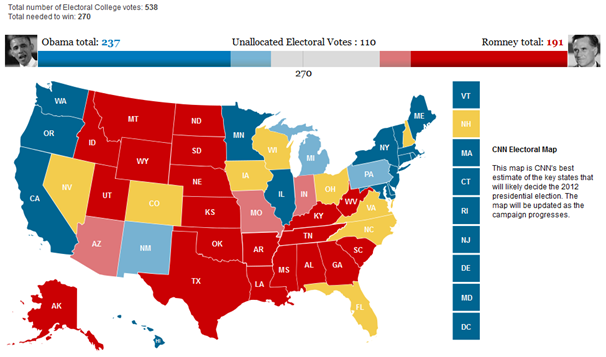
U.S. foreign policy is impacted by American interests. How “We The People” participate in democracy pretty much paints the picture for the global village. Both contestants in tonight’s third and final debate have been tripping over each other to get to Ohio. There’s an historic American institution called The Electoral College. It has no campus and no scheduled classes, but its math counts in presidential elections.

There’s yet another historic institution that neither candidate for president wants to consider in a national security debate. That institution, established in perpetuity in 1712 today answers the “why” 12% of Ohioans must vote.

African Americans were among the first residents of Ohio. Most of these people were free, but undoubtedly, a small number of them were slaves. Ohio's first constitution, the Ohio Constitution of 1803, outlawed slavery. Despite this legal protection, African Americans faced much racism and discrimination in the state.

The state constitutional convention prohibited African-American men from voting. Black men and women could not serve in the militia, serve on juries, testify in court against whites, receive assistance at the "poor house," vote, or send their children to public schools. Many whites actively sought to prevent blacks from coming to Ohio, fearing a loss of jobs to African-American workers. Many white Ohioans were also racists. Despite the discrimination that African Americans endured, many black Ohioans favored life in Ohio rather than living as slaves in the South.

Over time, conditions for African Americans improved in Ohio. During the nineteenth century, many whites actively assisted slaves in escaping from their owners along the Underground Railroad. Many of these same whites called for the Ohio government to extend equal rights to African Americans. During the twentieth century, especially during the 1950s, 1960s, and 1970s, the Civil Rights Movement raged, with both blacks and many whites seeking equality for people of all races.


CLICK HERE TO CALL STATE ELECTION OFFICIALS


Friday, September 28, 2012

Seventh Graders Learn-2-Earn

By Eric Stradford

AMWS, September 27, 2012, Marietta, GA – Life Science Learners at Marietta Middle School caught a glimpse of their own value as economic stimulus. A majority of the students in Justin Waller’s class already know they are winners.

Through a joint effort of the Cobb County Chamber of Commerce and Youth Achievers USA Institute, they learned today of a value-added link between their school studies and their future value in the American workforce. Any one of the winners in today’s classroom can pursue careers in pathology, genetics, or reproductive science. These three paths offer countless career choices in an economy of innovation.

Mr. Waller adds value to a vision of the winners’ future as an “educational ambassador” for Marietta City Schools. As Marietta School System’s Teacher of the Year, he advocates for the school system and its students. Citizens who earn the Teacher of the Year title are “exceptionally dedicated, knowledgeable, and skilled” according to the program website.

The teacher’s individual capacity to learn drew increased interest from school administrators, the Chamber of Commerce, and Youth Achievers USA Institute, a national public charity promoting American youth as future community assets. The teacher inspired students of all backgrounds and abilities to learn, showed respect and admiration of students and colleagues, and added value to the community as well as the school.

Both students and the visiting Teacher of the Day can tell you that Mr. Waller is a gifted scientist. He earned an education degree at Kennesaw State University after realizing he wanted to do more for his community. Among his accomplishments are the construction of an outdoor classroom which includes two greenhouses, a rose garden, benches, two flower boxes, and leading a "Go Green" club that picks up recyclable materials at least twice a week.

Today, seventh graders learned that life science is any science that deals with living organisms, their life processes, and their interrelationships as biology, medicine, or ecology. Basically, they learned about their own body systems by dissecting a frog.

Tomorrow, they must decide on their own path toward economic security. Lessons learned in S.T.E.M. and a community’s commitment to Positive Youth Development will ensure a path paved with opportunity.

Caring adults interested in stimulating the economy though investment on Our Streets, USA can CLICK HERE TO ENGAGE in Learn-2-Earn.


Monday, September 24, 2012

Stimulus for Our Street, USA

Investment in Human Capital…best foot forward

By Stephanie and Eric Stradford

AMWS, Washington, DC, Sept. 24, 2012 -- There’s a new stimulus for the American economy. It’s just over the horizon, but close enough for investors to bank on its future value. Before now, innovation economics has been another buzz word for the impossible dream. The plan for ending two wars, tackling defense spending, bailing out Wall Street, and Detroit has transparently matriculated before our very eyes. As Congress recessed from recess today, the Congressional Black Caucus Foundation shared a vision of America’s future.

clip_image002
Marine Corps Lieutenant General Willie J. Williams factored in the reality of a downsized military force and the impact of trained veterans returning to Our Street, USA. In the past, African American communities have received veterans with some hesitation. “After leaving the Marine Corps, I shared some news with schools, faith and community leaders about the Internet,” said one veteran. “They looked at me like I was crazy. When I started telling them about how this could impact their economic reality, some looked like a deer in the headlights of oncoming traffic.”

The 42nd Annual Legislative Conference, dubbed ALC 2012, highlights the CBCF mission to “develop leaders, inform policy and to educate the public.” Conference participants heard about a digital divide that’s been with us since Vice President Al Gore allegedly “invented” the Internet. Some of the key issue forums and brain trusts touched on real problems faced by a constituency of historically disadvantaged Americans. But other conversations just fed into bad habits among broad sectors of the African American Community. “You know who frustrates the so-called "blue dog" Democrat -- who block President Obama in the name of fiscal responsibility. Do they know that they are hindering economic recovery?” posted economist, author, and commentator. Dr. Julianne Malveaux,

Dr. Malveaux and other informed conventioneers seeking substance in a slew of rhetorical theorizing already see the light at the end of a divisive election. With no legitimate opponent left standing, Barack Obama wins by default. Never before in American history has a divisive contest produced such a possibility for a political win-win. Skipping past scheduled debates, the possibility of another questionable election and right to Mitt Romney’s succession speech promotes one short path to common vision for America’s future.

Right now, the shortest distance between the $16 trillion national debt and economic recovery is a straight line. Or, for the sake of debate -- a line segment, connecting point A to point B. The classic answer in mathematics, underscores Arkansan wisdom from former President Bill Clinton. Mr. Clinton reminded America, the economy comes down to arithmetic. That holds true for elections as well as governing after elections. America works best when citizens engage and support their collective decisions.

The math is far more significant for men and women of the U.S. Armed Forces. A majority of voters elect the president. A majority in Congress appropriates public funds. A majority of veterans follow orders in defense of national security. A change in policy resulting in reduced combat forces means an increase in veterans returning home. High unemployment rates among veterans reflect an America’s failure. If a veteran fights for us over there, we should fight for you over here. However, the more trained veterans in the workforce, the more first-jobbers get laid off.

Like Mr. Clinton said, it’s arithmetic. Moving forward with investment in human capital is essential if America is to be strong in both the public and private sectors. Our future depends on it!