Monday, October 22, 2012

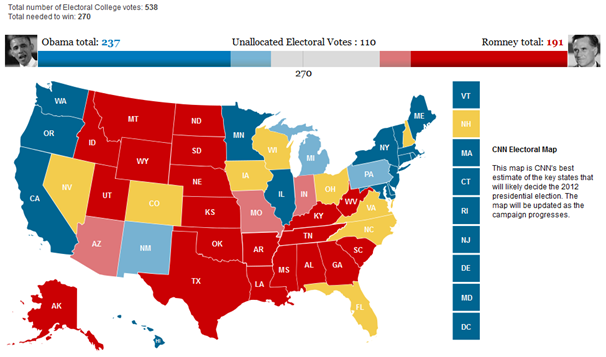
Why Every 1 in 6 Million Ohioans Need To Vote Early

By Eric and Stephanie Stradford
image

AMWS, October 21, 2012, Cleveland, OH – The State of Ohio reported that 1.4 million Ohioans have either cast or requested an absentee ballot for the November 6 General Election. The Ohio Secretary of State’s website now informs the last of 7.9 million Ohio voters WHERE they can go for early voting. 

UPDATE (3:49 pm 10/22) --  Find Your Polling Location

Ohio Secretary of State Jon Husted’s “encouragement” could have been a little more enthusiastic since voting is one of those inalienable rights celebrated through American citizenship. Instead, regarding the U.S. Supreme Court’s denial of a stay of the Sixth Circuit Court of Appeals’ decision in Obama v. Husted, the Secretary told Ohioans, “Despite the Court’s decision today, to deny our request for a stay, I firmly believe Ohio and its elected legislature should set the rules with respect to elections in Ohio, and not the federal court system.”

The Ohio Secretary of State issued DIRECTIVE 2012-50 to all County Boards of Elections which, “expands the uniform days and hours for in-person absentee voting established by Directive 2012-35, which remains in effect. As such, Boards are reminded that any voter in line when that day’s hours for in-person absentee voting ends may remain in line to apply for and receive an absentee ballot in person.”

If you are one of the 6.5 million Ohioans who have not voted, you should vote:

Saturday, November 3, 2012 – 8:00 a.m. to 2:00 p.m.
Sunday, November 4, 2012 – 1:00 p.m. to 5:00 p.m.
Monday, November 5, 2012 – 8:00 a.m. to 2:00 p.m.

If you do not vote on one of these days, it is imperative, RAIN, SNOW or SHINE that you cast your ballot on November 6. You may need to call the Secretary of State for information on where to vote. His number is 877-767-6446.
 
Despite all our individual and collective efforts, too many eligible voters won’t get the word unless one connected somebody visits, calls, or emails a friend and tell them what needs to be done and why. Some are still waiting for the last hour on Tuesday, November 6 to arrive at the polls just in time to be disenfranchised.

The “issue” for about 11,544,951 Americans who live, work and worship here is about trust. It’s about shaking loose from shackles that keep you and others like you poor, stupid and locked up.

If every Ohioan could vote in the November 6 election for president, 5,887,925 would count as a 51% majority for 4% of the total U.S. population. Perhaps a simpler formula might be to divide four in half and get a 2% majority of a minority that only counts on Election Day. Being counted in the minority has been a major part of the problem across the U.S – even in Ohio.

U.S. foreign policy is impacted by American interests. How “We The People” participate in democracy pretty much paints the picture for the global village. Both contestants in tonight’s third and final debate have been tripping over each other to get to Ohio. There’s an historic American institution called The Electoral College. It has no campus and no scheduled classes, but its math counts in presidential elections.

There’s yet another historic institution that neither candidate for president wants to consider in a national security debate. That institution, established in perpetuity in 1712 today answers the “why” 12% of Ohioans must vote.

African Americans were among the first residents of Ohio. Most of these people were free, but undoubtedly, a small number of them were slaves. Ohio's first constitution, the Ohio Constitution of 1803, outlawed slavery. Despite this legal protection, African Americans faced much racism and discrimination in the state.

The state constitutional convention prohibited African-American men from voting. Black men and women could not serve in the militia, serve on juries, testify in court against whites, receive assistance at the "poor house," vote, or send their children to public schools. Many whites actively sought to prevent blacks from coming to Ohio, fearing a loss of jobs to African-American workers. Many white Ohioans were also racists. Despite the discrimination that African Americans endured, many black Ohioans favored life in Ohio rather than living as slaves in the South.

Over time, conditions for African Americans improved in Ohio. During the nineteenth century, many whites actively assisted slaves in escaping from their owners along the Underground Railroad. Many of these same whites called for the Ohio government to extend equal rights to African Americans. During the twentieth century, especially during the 1950s, 1960s, and 1970s, the Civil Rights Movement raged, with both blacks and many whites seeking equality for people of all races.


CLICK HERE TO CALL STATE ELECTION OFFICIALS


Friday, September 28, 2012

Seventh Graders Learn-2-Earn

By Eric Stradford

AMWS, September 27, 2012, Marietta, GA – Life Science Learners at Marietta Middle School caught a glimpse of their own value as economic stimulus. A majority of the students in Justin Waller’s class already know they are winners.

Through a joint effort of the Cobb County Chamber of Commerce and Youth Achievers USA Institute, they learned today of a value-added link between their school studies and their future value in the American workforce. Any one of the winners in today’s classroom can pursue careers in pathology, genetics, or reproductive science. These three paths offer countless career choices in an economy of innovation.

Mr. Waller adds value to a vision of the winners’ future as an “educational ambassador” for Marietta City Schools. As Marietta School System’s Teacher of the Year, he advocates for the school system and its students. Citizens who earn the Teacher of the Year title are “exceptionally dedicated, knowledgeable, and skilled” according to the program website.

The teacher’s individual capacity to learn drew increased interest from school administrators, the Chamber of Commerce, and Youth Achievers USA Institute, a national public charity promoting American youth as future community assets. The teacher inspired students of all backgrounds and abilities to learn, showed respect and admiration of students and colleagues, and added value to the community as well as the school.

Both students and the visiting Teacher of the Day can tell you that Mr. Waller is a gifted scientist. He earned an education degree at Kennesaw State University after realizing he wanted to do more for his community. Among his accomplishments are the construction of an outdoor classroom which includes two greenhouses, a rose garden, benches, two flower boxes, and leading a "Go Green" club that picks up recyclable materials at least twice a week.

Today, seventh graders learned that life science is any science that deals with living organisms, their life processes, and their interrelationships as biology, medicine, or ecology. Basically, they learned about their own body systems by dissecting a frog.

Tomorrow, they must decide on their own path toward economic security. Lessons learned in S.T.E.M. and a community’s commitment to Positive Youth Development will ensure a path paved with opportunity.

Caring adults interested in stimulating the economy though investment on Our Streets, USA can CLICK HERE TO ENGAGE in Learn-2-Earn.


Monday, September 24, 2012

Stimulus for Our Street, USA

Investment in Human Capital…best foot forward

By Stephanie and Eric Stradford

AMWS, Washington, DC, Sept. 24, 2012 -- There’s a new stimulus for the American economy. It’s just over the horizon, but close enough for investors to bank on its future value. Before now, innovation economics has been another buzz word for the impossible dream. The plan for ending two wars, tackling defense spending, bailing out Wall Street, and Detroit has transparently matriculated before our very eyes. As Congress recessed from recess today, the Congressional Black Caucus Foundation shared a vision of America’s future.

clip_image002
Marine Corps Lieutenant General Willie J. Williams factored in the reality of a downsized military force and the impact of trained veterans returning to Our Street, USA. In the past, African American communities have received veterans with some hesitation. “After leaving the Marine Corps, I shared some news with schools, faith and community leaders about the Internet,” said one veteran. “They looked at me like I was crazy. When I started telling them about how this could impact their economic reality, some looked like a deer in the headlights of oncoming traffic.”

The 42nd Annual Legislative Conference, dubbed ALC 2012, highlights the CBCF mission to “develop leaders, inform policy and to educate the public.” Conference participants heard about a digital divide that’s been with us since Vice President Al Gore allegedly “invented” the Internet. Some of the key issue forums and brain trusts touched on real problems faced by a constituency of historically disadvantaged Americans. But other conversations just fed into bad habits among broad sectors of the African American Community. “You know who frustrates the so-called "blue dog" Democrat -- who block President Obama in the name of fiscal responsibility. Do they know that they are hindering economic recovery?” posted economist, author, and commentator. Dr. Julianne Malveaux,

Dr. Malveaux and other informed conventioneers seeking substance in a slew of rhetorical theorizing already see the light at the end of a divisive election. With no legitimate opponent left standing, Barack Obama wins by default. Never before in American history has a divisive contest produced such a possibility for a political win-win. Skipping past scheduled debates, the possibility of another questionable election and right to Mitt Romney’s succession speech promotes one short path to common vision for America’s future.

Right now, the shortest distance between the $16 trillion national debt and economic recovery is a straight line. Or, for the sake of debate -- a line segment, connecting point A to point B. The classic answer in mathematics, underscores Arkansan wisdom from former President Bill Clinton. Mr. Clinton reminded America, the economy comes down to arithmetic. That holds true for elections as well as governing after elections. America works best when citizens engage and support their collective decisions.

The math is far more significant for men and women of the U.S. Armed Forces. A majority of voters elect the president. A majority in Congress appropriates public funds. A majority of veterans follow orders in defense of national security. A change in policy resulting in reduced combat forces means an increase in veterans returning home. High unemployment rates among veterans reflect an America’s failure. If a veteran fights for us over there, we should fight for you over here. However, the more trained veterans in the workforce, the more first-jobbers get laid off.

Like Mr. Clinton said, it’s arithmetic. Moving forward with investment in human capital is essential if America is to be strong in both the public and private sectors. Our future depends on it!


Monday, August 27, 2012

YouthUSA Targets Acworth as New Market

"Discovering God's New Possibilities” for Our Street, USA

clip_image002[4]


YouthUSA National Director Yvonne Griswold, an economist for the federal government, met with Acworth Youth Achiever Mariasonniah Smith (center) and her sisters to talk about Money-n-the-Bank goals.

By Stephanie and Eric Stradford

AMWS, August 26, 2012, Acworth, GA - Economists for a national public charity are “paying attention” to new market investment opportunities for Our Street, USA.

Mariquel E. Smith, 11 and Desiree L. Moore, 20 of Acworth are attracting national attention to their hometown through their vision for “fellowship” with “a whole village” of caring adults. The latest candidates for THE ANNUAL YOUTH ACHIEVEMENT AWARDS are local residents who “believe I can achieve whatever I believe I can achieve.” Last year, Mariasonniah Smith, 13 of Acworth, leveraged her Money-n-the-Bank goals to a $1000 fellowship commitment from Youth Achievers USA Institute. Mary-Pat Hector, 15, a youth activist from Jonesboro also qualified for benefits in 2011.

New candidates and recent winners visited Acworth’s historic Bethel African Methodist Episcopal Church for an “Open House” event. YouthUSA Director Yvonne R. Griswold, an economist for the federal government, joined asset managers and mentors to add value to vision for the Acworth community. “Any inclusive vision for America’s future must consider economic needs where Americans live, learn, work and worship,” said Griswold.

The Reverend Leela Brown Waller, pastor for the Bethel congregation, kicked off a season of "Discovering God's New Possibilities." Ironically, the congregation worships at the intersection of Bell and School Streets, a metaphorically significant crossroad marker for church (Bell) and state (School).  “I’m so glad you’re here to see our Acworth community during construction so that you can witness the new possibilities after God completes His plan," said Waller.

clip_image004[4]

GAME ON! The Reverend Leela Brown Waller, Historic Bethel AME Church’s new pastor is also a former cheerleader for the Atlanta Falcons.

Established in 1864, The Bethel AME Church congregation originally shared a church building with the Zion Hill Baptist Church. Members built the current structure between 1871 and 1882.

Registers of Historic Places promote Bethel and Zion Hill as “home to small African American congregations.” The Cobb County Landmarks and Historical Society reports, “this church structure is threatened by lack of funding for repairs.”

Waller’s commitment to "Discovering God's New Possibilities" sets a positive tone for local kingdom building at a time of global economic uncertainty. Her “cheerleader spirit” may prove to be just the right prescription for economic healing on Main Street, USA. Just across the tracks from Bethel’s historical community, Acworth City officials are at work on a vision of the city’s future.

Road construction at Bell and School Streets offer evidence of “new possibilities” on the way. Bell and School Streets are at the heart of future enterprise. The State of Georgia has designated the City of Acworth’s Redevelopment Area as an “Opportunity Zone.” The designation allows any existing business or a business that locates into zone to apply to the State for a $3,500 job tax credit.

clip_image006[4]
ACWORTH'S EMPOWERMENT: Mayor Tommy Allegood (front/center) and Acworth city officials value faith in their vision of the community’s future.  New possibilities are being discovered where Americans live, learn work and worship.

Local job creation is at heart of this community’s vision of its own future. Church and State working together is already adding value to vision for Acworth. Up the road from Historic Bethel is the Roberts School Community Education Center where YouthUSA is “discovering” common vision for Positive Youth Development. The Acworth Achievers after-school youth program primarily serves low income youth from the surrounding community. The program, run by the city’s parks and recreation department, partners with local schools to improve learning outcomes. At the same time, schools as well as churches struggle to meet needs with declining assets. Financial services professionals say that while lingering economic downturns can generate investor concern, they can also generate investment opportunities.

YouthUSA has been mapping assets in Acworth seeking answers to economic issues.  Acworth’s youth are like buried treasure for the region’s economic. BB&T.com posted, “When the economy is in a slow-growth or no-growth mode and the stock market shifts dramatically up or down with little warning, what’s the best plan of action? The answer, in most cases, is “It depends…”

clip_image008[4]

The most effective approach to economic inclusion is learning to earn.  YouthUSA’s approach starts with financial literacy and integrates diverse components—endowments, investments, insurance, savings for education, home, and small business ownership. Cross generational wisdom invested by caring adults offer insight on retirement, credit, charitable giving, tax and estate planning for a unified, coordinated strategy.

YouthUSA beneficiaries depend on partnering banks, charitable foundations and friends to value their futures as assets for economic recovery. Each qualifying youth commits to a vision of his or her own future as an asset and, therefore, not a liability to their community. YouthUSA’s expanded definition of community considers needs beyond geographic boundaries, connecting local needs to a wealth of resources. To partner with this new market for community reinvestment, contact YouthUSA at www.YouthUSA.net.


Friday, August 10, 2012

In It To Win It!


YouthUSA winners offered positive alternative to negative values

by Stephanie and Eric Stradford

AMWS, August 10, 2012, Virtual -- The rapidly eroding race for President of the United States, fueled by negativity, banked by conflicting ideals and evinced by high cost advertising, pitting America against America has taken its toll on America’s future.

Two name-calling, back-biting rich guys, fighting over occupancy of a public housing project, brings shame and dishonor to that which WE THE PEOPLE envision as One Nation Under God. It needs to stop…NOW!

Somewhere in the quantification of yesterday’s national negative political debate, there’s a negative $15.9 trillion national debt. Unless someone can spin positive value from negative political campaigning, that practice impedes the process of making America work. It needs to stop…NOW!

Youth Achievers USA Institute, a 501c3 public charity, promotes an inclusive "vision of the future" for citizens in America's economy. The bottom line is clear to leaders with enough common sense to pay attention. Some youth have access to inheritance, endowments, or trust funds that offer a hand up in pursuing their American dream. Others still perceive theirs to be a dream deferred. YouthUSA hopes to demonstrate, on a small scale, that an inheritance can be developed for historically disadvantaged as well as mainstream Americans. The demonstration engages youth beneficiaries as “assets for independence.”

The Federal Assets for Independence (AFI) program provides five-year grants to nonprofit organizations and government agencies that empower low-income families to become economically self-sufficient for the long-term. Grantees provide financial education training on money management issues, and they assist participants with saving earned income in special matched savings accounts called Individual Development Accounts (IDAs). Participants use the IDAs to accumulate funds with the goal of acquiring a first home, post-secondary education, or starting up or expanding a small business.

Economist Yvonne Griswold provides leadership to caring adults interested in managing community assets where they live, learn, work and worship. Her own testimony as a YouthUSA beneficiary adds substance to hope for “believing I can achieve.” The 2007 graduate of Southern University of Baton Rouge holds a masters degree in economics and serves as an economist for the U.S. Government. As Task Force Chair for THE ANNUAL YOUTH ACHIEVEMENT AWARDS, Griswold provides executive counsel on ways and means for sustaining “the whole village.”

YouthUSA economic development programs seek to engage local communities in developing youth as future “community assets.” Financial incentives encourage measurable Positive Youth Development by matching community investments in qualifying beneficiaries with program funds from the sponsoring 501c3 public charity.

The Interagency Working Group on Youth Programs, a collaboration of twelve federal departments and agencies that support youth, has created a definition of positive youth development: Positive youth development is an intentional, pro-social approach that engages youth within their communities, schools, organizations, peer groups, and families in a manner that is productive and constructive; recognizes, utilizes, and enhances youths' strengths; and promotes positive outcomes for young people by providing opportunities, fostering positive relationships, and furnishing the support needed to build on their leadership strengths.

New applicants to THE ANNUAL YOUTH ACHIEVEMENT AWARDS and their caring adult supporters are being invited to join Griswold’s Task Force as part of a YouthUSA board leadership program. The Task Force will also discuss YouthUSA fellowships as part of a $5 million development fund.

“I’m so excited to be a part of a community of people who are excited about our youth,” said Griswold. Griswold’s enthusiastic interest demonstrates community reinvestment and challenges future leaders to “pay attention” when somebody wants to invest in you.

JOIN US NOW -- America's Future Begins Today at YouthUSA


Thursday, May 10, 2012

America’s Going Virtual -- Who gets left behind?

By Stephanie and Eric Stradford

AMWS, May 10, 2012, Virtual -- After her chainsaw incident in Diary of a Mad Black Woman, Tyler Perry’ fictitious Madea, placed under house arrest with an ankle bracelet, touches ever so lightly on the evolving social science behind virtual incarceration.

In real-life Washington, DC, the “Po Po” used virtual traffic management to “tag” an unsuspecting speeder. They photographed the license plates, sent a digital image via snail mail and demanded payment. Whether you did it or didn’t is a non issue. You pay the fine, and everything is just fine.

The economic reality of higher gas prices, overpopulated prisons and shrinking budgets is moving art closer to science and, science closer to faith. The National Science Foundation now describes a virtual organization as “a group of individuals whose members and resources may be dispersed geographically, but who function as a coherent unit through the use of cyber infrastructure.”

Sometime before NSF came to accept this perception, a faithful few of the world’s 1.3 billion Christians believed in a “substance of things hoped for” and “evidence of things not seen.” The Apostle Paul described an entity as such in his letter to the Corinthians. “Let there be no divisions in the church,” he wrote. “Rather, be of one mind, united in thought and purpose.”

Paul’s letter reflected a vision of the future for a virtual entity believed by some to be Church Universal. In September 2006, organizers for Youth Achievers USA Institute followed a vision for virtual existence, parked it in a regional community identified by the federal government as The Atlanta Federal Reserve Region, and set up shop at www.YouthUSA.net.

Some non-believers in the six-state region thought it far-fetched to operate from the Internet. “How do I get to your office?” they would ask. “Where should I send your mail?” Or, our favorite, what’s your local church affiliation…you know, where you worship, serve and pay your tithes and offerings? “Haven’t seen you guys in a while,” said one bishop. There was no appropriate response to offer.

The unfortunate reality for religious resisters to change can be summed up in the now familiar heartbreaker, “it’s the economy…stupid.” Once upon a time, burning questions about whether operations via Internet could be (or not be) mattered. That “crystal ball” revealed that 80.6% of 2.5 million African Methodists think the government should do more to help needy Americans. By comparison, four other groups surveyed included American Baptist Churches in the USA (67.1%), Church of God in Christ (76.7%), United Methodist Church (55.5%) and Atheists (65.4%), In reality, the government is doing more to help people in need. But there’s a disconnect between hungry folk, folks with food and folks with information to locate the chow line.

“Virtual organizations are increasingly central to the science and engineering projects funded by the National Science Foundation,” states a current federal grant announcement. “Focused investments in socio-technical analyses of virtual organizations are necessary to harness their full potential and the promise they offer for discovery and learning.”
The National Science Foundation’s VOSS program (Virtual Organizations as Socio-technical Systems) does not support proposals that aim to implement or evaluate individual virtual organizations, the grant applies federal dollars to scientific research, particularly advances in social, organizational and design. Political Scientists need to study how to develop virtual organizations and under what conditions virtual organizations can enable and enhance scientific, engineering, and education production and innovation.

Disciplinary perspectives may include (but are not limited to) anthropology, complexity sciences, computer and information sciences, decision and management sciences, economics, engineering, organization theory, organizational behavior, social and industrial psychology, public administration, political science and sociology.

Unemployed or underemployed church members may hold advance degrees in some of these areas. They have been hearing, “you are over qualified.” But the reality is that they have been looking in the wrong place. Many will migrate to ministry without a clue of the endless opportunities for that discipline in the global economy.

Tuesday, May 8, 2012

Once Upon An Ebu

Retired Merck Exec’s cheerful giving aids family ministry

By Eric and Stephanie Stradford

AMWS, May 8, 2012, Philadelphia, PA -- Once upon a time, in a land not so far away, in a little metropolis called Philadelphia, there was born and raised a young chap who stuttered. No one really knew why the young chap stuttered. He always seemed to have so much to say and so little time to say it that the words got in the way. But there was one who always believed that this young tadpole would one day be a full grown bullfrog and hop by all the people who didn’t believe he could achieve whatever he believed he could achieve.

The young chap often shared a weekend with a kindly corporate library scientist who had matriculated through the historically black Howard University of Washington, DC and the Prestigious Drexel University of Philadelphia. The kindly corporate library scientist took a special interest in the young chap’s positive youth development. Although she had known the young chap’s mom all her life, she knew little about her goals, beliefs and aspirations. Afterall, what one person really knows everything about another?

The young chap lived in a section of town known to have presented economic security challenges. The community had given birth to urban renewal models, innovations in social economics, religious collaboration, and university expansion. But, with all its achievements, the community had yet to sustain social development and economic growth for a generation of distressed families.

Perhaps this young chap and his unique situation was “the man” that would bring change to his family and a community of distressed, disillusioned, disenfranchised Americans. “What would it take,” the kindly corporate library scientist wondered, “to prepare this youngster for a life more abundantly?” She already knew about knowledge being power. By her own example, she had demonstrated the value of a good education in making a life for herself and those she loved. She had been raised to trust in God and lean not to her own understanding.

As a professional library scientist, she knew books, in which a wealth of words had endowed her with critical skills. She could read, write, calculate, communicate, think reason and use good judgment. The kindly corporate library scientist was ready willing and able to be value-added human capital needed to impact this young chap’s “temporal economy.”

The young chap had never before heard this term, “temporal economy.” As a young tadpole barely exhumed from mommy’s womb, his story evolved from a family’s vision of his future. To his favor, the young chap got to spend some quality time with the kindly corporate library scientist . The young chap came to know and love her as “Aunt Ebu.” Not only was Aunt Ebu a corporate library scientist , she was the matriarch in a bloodline of empowered Americans known as The Walkers. In her best years, she had become the young chap’s strongest link to legitimacy as a fully endowed American. It was to Aunt Ebu’s credit that the young chap learned about the computer, and accessed an unlimited source for learning called the Internet.

She welcomed other family members who were ready, willing and able to carry on the values of her dad and mom, J.D. and Laurena Walker. She hoped that by telling the story of these ordinary people, their good works would live on through this young lad, his siblings and perhaps their children’s children.

One day, Aunt Ebu took young Niyko to see the movie, “Red Tails.” It was a story about the Tuskee Airmen, a group of African Americans who fought from the air during World War II. Niyko learned that the story had special meaning for Aunt Ebu because she had lived during that era. Her experiences endowed her with a greater appreciation for her parent’s teachings that, “With God All Things Are Possible.” She shared with Niyko her own recollection as her granny’s little black girl. She grew up at a time when African Americans were treated as second class citizens. She went to college, found work in corporate America and became a philanthropist so no black child would ever have to wonder whether they could make a difference. Aunt Ebu made Black history month real for Niyko.

She showed him the workbook from The Walker Summit on Family Values, an event which introduced Nikyo’s mom, his maternal grandfather and their siblings to J.D. and Laurena Walker. Aunt Ebu shared a story. She had Niyko read it. She endowed him with a chance to be an asset and not a liability to the Walker Family.

Niyko’s decision would give his life purpose. All of a sudden, it made sense that the computer could lead him to good information or bad information. It was up to him to decide. This was the day that Niyko decided he would apply to THE ANNUAL YOUTH ACHIEVEMENT AWARDS, and begin to use the information to carry on the good name the Walkers had given to him.

He asked Aunt Ebu, “What is a Spiritual Goal?” She answered, “that means deciding to live your life as God wants you to.” “How do I know what God wants me to do,” he asked. She took him to church with her, and introduced him to some caring adult believers. “Niyko wants some help writing a Spiritual Goal. He is doing what Jesus said in Matthew 6:33, “Seek first the kingdom of heaven and all its righteousness, and all these things shall be added unto you.”

One of Aunt Ebu’s caring adult friends asked Niyko, “Are you saved?” “I think so,” Niyko responded. The caring adult then said to Niyko, “Don’t think…KNOW.” This is like the most important thing you can do in your life. Make a decision right now to be an asset in God’s Kingdom and always remember this decision. “YES!!!!” said Niyko. I want to be an asset in God’s kingdom because Aunt Ebu taught me that ALL THINGS are possible with God.” She said, “God will never leave me alone. I will always remember that.”

All of a sudden, The God’s Word touched Niyko’s heart, and the words from his mouth brought credit to the Walker Family name. He knew that God had his back, and he was ready to be an asset to his Aunt Ebu’s legacy.